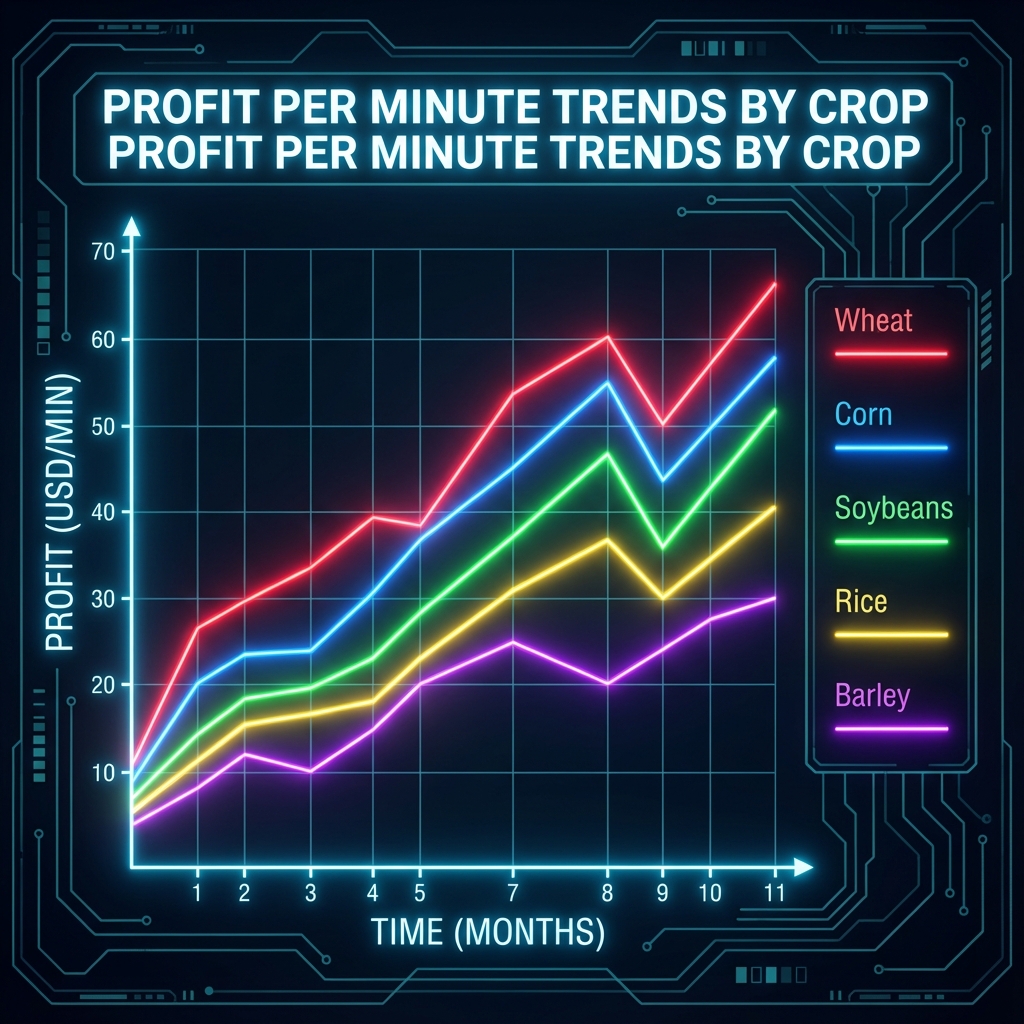
Why the Value Calculator is Essential
The Value Calculator is the most powerful tool for serious Grow a Garden players. It eliminates guesswork, reveals hidden profit opportunities, and helps you make data-driven decisions that can double or triple your coin generation rate.
Most players never learn to use it properly, relying instead on intuition and trial-and-error. This guide teaches you professional techniques that top players use to optimize every aspect of their farming strategy.
Basic Calculator Functions
Step 1: Select Your Crop
Choose from the dropdown menu of all available crops. The calculator automatically loads that crop's stats: seed cost, sell price, growth time, and multi-harvest count.
Step 2: Enter Your Quantity
Input how many plots you plan to use. The calculator multiplies all results by this number, showing total investment and returns.
Step 3: Review the Results
The calculator displays:
- Total Seed Cost: Your upfront investment
- Total Sell Value: Revenue from selling all crops
- Net Profit: Sell value minus seed cost
- Profit Per Minute: The most important metric
- Time to Harvest: When crops will be ready

Advanced Techniques
Technique #1: Comparative Analysis
Don't just calculate one crop – compare multiple options:
- Calculate tomatoes with 10 plots
- Note the PPM (profit per minute)
- Calculate peppers with 10 plots
- Compare PPM values
- Choose the higher PPM crop
Pro Tip: Open the calculator in multiple tabs to compare crops side-by-side!
Technique #2: Capital Optimization
Find the maximum number of crops you can afford:
- Note your current coin balance
- Enter different quantities until total seed cost matches your balance
- This shows your maximum planting capacity
Example: You have 5,000 coins. Tomato seeds cost 150 each. Calculator shows you can plant 33 tomatoes (4,950 coins).
Technique #3: ROI Timeline Planning
Calculate how long until you recover your investment:
- Total seed cost: 3,000 coins
- Net profit per cycle: 1,500 coins
- ROI: 2 harvest cycles (16 minutes for tomatoes)
This helps you decide if expensive crops are worth the risk.
Technique #4: Multi-Harvest Optimization
For multi-harvest crops, calculate total value across all harvests:
- Strawberries: 5 harvests × 420 coins = 2,100 total value
- Seed cost: 250 coins
- True profit: 1,850 coins per seed!
The calculator shows this automatically, revealing why multi-harvest crops are so profitable.
Professional Strategies
The 50/30/20 Portfolio Method
Use the calculator to build a balanced farm:
- 50% High PPM: Calculate best PPM crop (usually tomatoes)
- 30% Fast Rotation: Calculate fast crops (corn, peppers)
- 20% Long-Term: Calculate slow, high-value crops (pumpkins)
This ensures constant harvests while maximizing overall PPM.
The Break-Even Analysis
Before planting expensive crops, calculate your break-even point:
- Calculate total seed cost for expensive crop
- Calculate how many cheap crop harvests equal that cost
- Decide if the expensive crop's benefits justify the risk
Example: Pumpkin seeds cost 400 coins. That's 8 corn harvests (50 coins profit each). Is the pumpkin worth 8 corn cycles? Use PPM to decide!
The Scaling Calculator
Plan your farm expansion:
- Calculate current setup profit per hour
- Calculate profit with +5 plots
- See exactly how much more you'll earn
- Decide if plot expansion is worth the cost
Common Calculator Mistakes
Mistake #1: Ignoring PPM
Players look at total profit and ignore profit per minute. A crop with 1,000 coin profit but 30-minute growth might be worse than a 200-coin crop with 5-minute growth.
Mistake #2: Not Accounting for Playstyle
The calculator shows theoretical maximums, but if you can't harvest every 5 minutes, fast crops waste potential. Calculate based on YOUR actual play schedule.
Mistake #3: Forgetting Multi-Harvest Bonuses
The calculator accounts for multi-harvest, but players forget this when comparing to single-harvest crops. A 4-harvest tomato isn't 4x better – it's exponentially better due to saved seed costs!
Mistake #4: Not Updating for Pets/Upgrades
The calculator shows base values. Mentally add your pet bonuses (+15-20%) and plot upgrades (+25-30%) to get true profits.
Calculator Power User Tips
Tip #1: Bookmark Your Favorites
Create bookmarks for your most-used crop calculations. Quick access saves time when making fast decisions.
Tip #2: Screenshot Comparisons
Take screenshots of calculator results for different crops. Build a personal reference guide of PPM rankings.
Tip #3: Calculate Before Every Session
Crop values and your capital change. Recalculate your optimal crops at the start of each play session.
Tip #4: Use With Other Tools
Combine the Value Calculator with the Growth Calculator to plan perfect harvest schedules, and the Profit Analyzer for quick comparisons.
Real-World Example: Optimizing a 10-Plot Farm
Scenario: You have 10 plots and 5,000 coins. What should you plant?
Step 1: Calculate Options
- Tomatoes (10 plots): 1,500 seed cost, 3,600 profit, 45 PPM
- Corn (10 plots): 800 seed cost, 1,800 profit, 36 PPM
- Pumpkins (10 plots): 4,000 seed cost, 6,380 profit, 29 PPM
Step 2: Analyze Results
Tomatoes have the best PPM (45) and fit your budget. Pumpkins have higher total profit but worse PPM and use 80% of your capital (risky!).
Step 3: Make Decision
Plant 10 tomatoes. You'll earn more per minute and keep 3,500 coins as a safety buffer.
Result
After 8 minutes, you harvest 3,600 coins. Replant immediately. After 1 hour, you've completed 7.5 cycles for 27,000 coins profit. Pumpkins would have earned only 6,380 coins in the same time!
Conclusion: Calculate Your Way to Success
The Value Calculator transforms guesswork into science. By mastering comparative analysis, ROI calculations, and PPM optimization, you'll make smarter decisions that compound into massive profit advantages over time. Every successful farmer uses this tool religiously – now you know why!